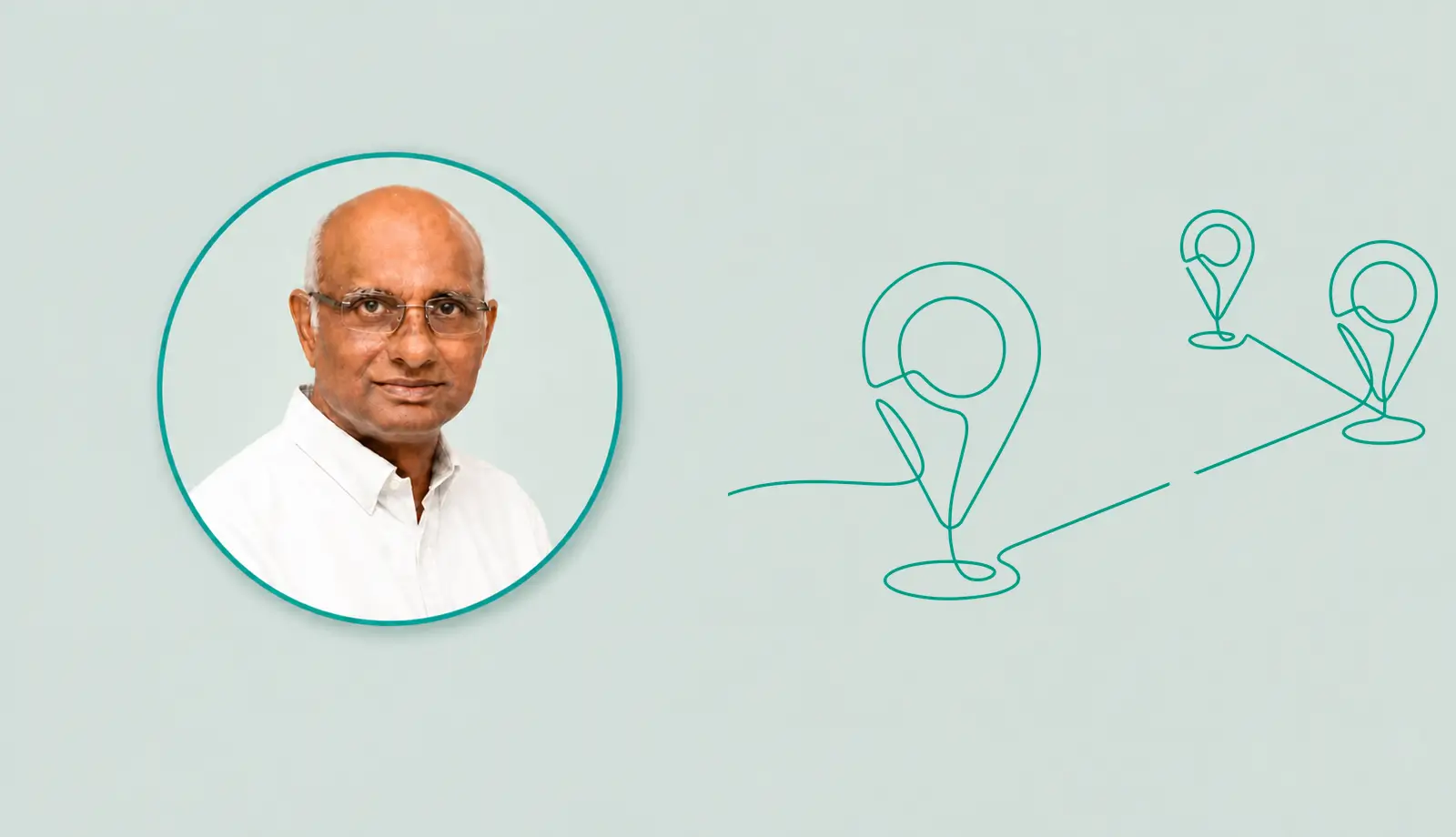
A/Prof Kumar Gogna, paediatrician turned radiation oncologist, founding director of Radiation Oncology Queensland, and lifelong advocate for equitable access to radiation therapy.
A conversation with A/Prof Peter Gorayski, Chair of Targeting Cancer’s Management Committee, and A/Prof Kumar Gogna, paediatrician turned radiation oncologist, founding director of Radiation Oncology Queensland, and lifelong advocate for equitable access to radiation therapy.
Few careers embody the mission of Targeting Cancer as completely as A/Prof Kumar Gogna’s. Across nearly five decades—first as a paediatrician serving remote Northern Territory communities, including East Arnhem Land, and then as a radiation oncologist who helped seed treatment services across regional Queensland—he has pursued a single question: how do we bring good cancer care closer to the people who need it? As one of three founding directors of Radiation Oncology Queensland in 2007, Kumar helped build what grew into one of Australia’s largest cancer care providers (Icon Group). He established Queensland’s first prostate seed brachytherapy program, led TROG trials that helped establish bladder-preserving chemoradiation, examined RANZCR Part II Fellowship candidates for more than a decade, and has mentored radiation oncology teams from Singapore to Mongolia. His story is also the story Targeting Cancer exists to tell: that radiation therapy is safe, effective and central to modern cancer care, and that too many patients who stand to benefit still miss out.
Most radiation oncologists train straight through. You spent 13 years as a paediatrician in remote Northern Territory communities, including East Arnhem Land, before moving into radiation oncology. What pulled you across — and did caring for Aboriginal children in under-resourced settings shape how you later thought about cancer care?
Childhood cancer is uncommon, but every so often I would diagnose a child with one. They were usually flown to the Adelaide Children’s Hospital, and some went on to have radiation therapy. Like most doctors of my generation — and, honestly, most medical graduates even today — I had had very little exposure to radiation oncology. Watching those children’s journeys made me want to understand it properly, and in 1989 I moved to Sydney to train at St Vincent’s Hospital.
Paediatrics in Darwin shaped me in a deeper way. We cared for Aboriginal communities spread right across the Top End, which meant seriously ill children were often airlifted far from home — adding separation, financial and cultural strain to an already frightening time. It left me with a question I have never let go of: how do we bring good care closer to the people who need it?
In 2010 you co-authored “The GAP in Radiotherapy Services in Australia and New Zealand” — flagging that thousands of Australians who should have been receiving radiation therapy weren’t. Fifteen years later, has that gap closed, widened, or just shifted?
That paper showed that only about 30% of cancer patients in Australia and New Zealand were receiving radiation therapy, when the evidence suggests the figure should be just over 50%. We also had far too few treatment machines to meet that need, and the shortfall was worst in regional areas.
Fifteen years on, the picture has improved but not enough — utilisation now sits around 40%. We still don’t have the machines, the departments or the trained staff that optimal care requires. And with cancer becoming more common as the population grows and ages, demand will keep climbing. Unless both federal and state governments stay alert to this and keep funding in step with need, the gap will simply re-open in a new form.
You were one of three founding directors of Radiation Oncology Queensland in 2007, which seeded services in Cairns, the Gold Coast and Springfield, and eventually became ICON. What was the case you had to make at the time to get regional radiotherapy off the ground — and who pushed back?
Everywhere I worked, I saw the same problem. In training I ran clinics in regional New South Wales where patients had to travel to Sydney for treatment; when I moved to Brisbane in 1993, every radiation therapy department was still in the city, and country patients faced the same long journeys, later diagnoses and poorer outcomes. It echoed what I had seen in the Northern Territory.
Two colleagues, Professor Michael Poulsen and Associate Professor Jonathan Ramsay, shared the vision. The obstacle was money: radiation therapy is very cost-effective to deliver, but a centre is expensive to build, and governments were slow to act despite report after report. The turning point came in 2006–07, when federal funding opened to private providers for regional services. We partnered with St Andrew’s Hospital in Toowoomba, won the tender, and opened our first centre — the beginning of what became Radiation Oncology Queensland and, later, ICON. The mission never changed: the best cancer care possible, for as many people as possible, as close to home as possible.
You established the first prostate seed brachytherapy program in Queensland at Greenslopes in 2003, and 22 years later it’s still the only one in the southeast of the state. Why does this technique remain so underused, and which patients are quietly missing out as a result?
Seed brachytherapy is an excellent, minimally invasive option for men with low- to intermediate-risk localised prostate cancer. Its long-term results are on a par with surgery, just with a different set of possible side effects, so for the right man it can be a very good choice.
Why is it underused? Partly because we lack the large head-to-head trials that would settle the debate, and those trials are very hard to run. But the bigger reason, historically, is simpler: many men were never given the chance to sit down with a radiation oncologist and hear that it was even an option. That is changing as care becomes more team-based, with specialists planning together so the treatment fits the man’s medical situation and his own priorities. Newer techniques such as stereotactic radiotherapy are now adding another safe, effective and accessible choice.
Across TROG 97.01, 99.06 and the Phase III 02.03, you led trials that helped establish bladder-preserving chemoradiation as a real alternative to cystectomy. What did patients gain — and what made TROG 02.03, which you co-authored under the title “a moral dilemma,” so difficult?
What patients gained was a real alternative to having the bladder removed. Bladder-preserving treatment — combining radiation and chemotherapy after removing the tumour — is now an accepted option for selected patients, with results comparable to major surgery but the bladder kept intact.
The difficulty with the Phase III trial was almost a catch-22. This cancer mostly affects older, frailer patients, often with other health problems, which makes any trial hard to recruit for and to deliver. Meanwhile the younger, fitter patients — the easiest to enrol — were usually steered straight to surgery, which urologists still regarded as the gold standard. We simply couldn’t recruit enough patients, and the trial had to stop early. Those who did take part tolerated the combined treatment well, but we couldn’t draw firm conclusions about controlling the cancer. That was the real frustration behind it.
Across nearly fifty years of medicine, is there a patient or family whose story has stayed with you — and what did they teach you about radiation therapy that the trial data alone never could?
One patient stays with me. In 2024 a man in his forties, with a young family, was found to have an aggressive cancer in a deeply personal part of the body. The standard recommendation was radical surgery — an operation that would have left him profoundly changed, with a heavy toll on the life ahead of him. There was very little in the medical literature to guide us.
At our team meeting I argued for an alternative: intensive radiation and chemotherapy, keeping surgery in reserve only if we needed it. He and his urologist chose that path. He came through the treatment well, his pain settled, and scans a few months later showed the cancer had completely disappeared.
What he taught me is something no trial result can: the goal is never simply to treat the disease, but to protect the whole person and the life they want to keep living. Sometimes the gentler option is also the right one — you just have to be willing to look for it.
When a new patient sits across from you and hears the words “we’re recommending radiation,” what’s the fear or misconception you most often have to work through before treatment can even begin?
Any cancer diagnosis is frightening, and being told you need radiation therapy adds to that. But in my experience most people, even those who knew nothing about it beforehand, become quite comfortable once we have sat down, built some trust, and talked through exactly what the treatment involves and what to expect.
The fears that linger usually come from outside the clinic — frightening images of nuclear accidents, or a friend or relative who had a hard time years ago with older techniques. The answer is almost always time and reassurance: explaining things patiently, walking people through the department before they start, and introducing the radiation therapists and nurses who will look after them. Once someone can picture what is actually going to happen, most of the fear falls away.
You examined RANZCR Part II Fellowship candidates in pathology from 2009 to 2022 and helped redesign the curriculum. What worries you about the next generation of radiation oncologists, and what gives you hope?
I am optimistic. Radiation therapy will stay central to cancer care, even as the way we deliver it keeps changing. My main message to those coming through is that the field now moves so fast that a willingness to keep learning matters more than ever — in imaging, in understanding how cancers behave, and in combining radiation with newer drug therapies to get the best result with the fewest side effects.
Artificial intelligence is reshaping everything we do. Used well, with proper checks, it is a powerful tool — but it should sharpen human judgement, never replace it. The skill and care that one person brings to another should always sit at the centre of treatment.
You’ve mentored colleagues from Singapore to Mongolia to China — including helping the only radiation oncology centre in Mongolia transition to 3D conformal treatment. What does that international work tell us about what Australia takes for granted?
Cancer is rising everywhere, yet in many developing countries patients have little or no access to radiation therapy — there simply isn’t the equipment, the trained staff, or even reliable servicing to keep the machines running. Visiting Mongolia, I was heartened to see a dedicated team in Ulaanbaatar steadily move to more advanced treatments through sheer determination, despite real constraints. China, meanwhile, is investing heavily, though with its vast population it still has a long way to go.
What it taught me is how much we take for granted here. Health budgets are under pressure the world over, Australia included, but our patients can walk into a department and receive care that genuinely compares with the best centres in North America or Europe — and increasingly close to home. That is not the global norm, and it is worth protecting.
You’re now in a retirement chapter — still consulting, still on tribunals and advisory panels. If there were one message about radiation therapy you could land with the Australian public that hasn’t yet landed, what would it be?
If there is one thing I would want every Australian to know, it is that radiation therapy is safe, effective and a core part of treating many cancers — sometimes on its own, sometimes alongside surgery or chemotherapy. Modern treatment is remarkably precise: we target the cancer while sparing the healthy tissue around it, so side effects are usually mild, localised and manageable with the right support. For many people it offers a cure. For others it controls the disease and extends life. And when cancer is advanced, it can ease pain and other symptoms so people live more comfortably. My hope, in whatever time I keep working, is simply that it becomes far better understood than it is today.